
"Trust the Process"
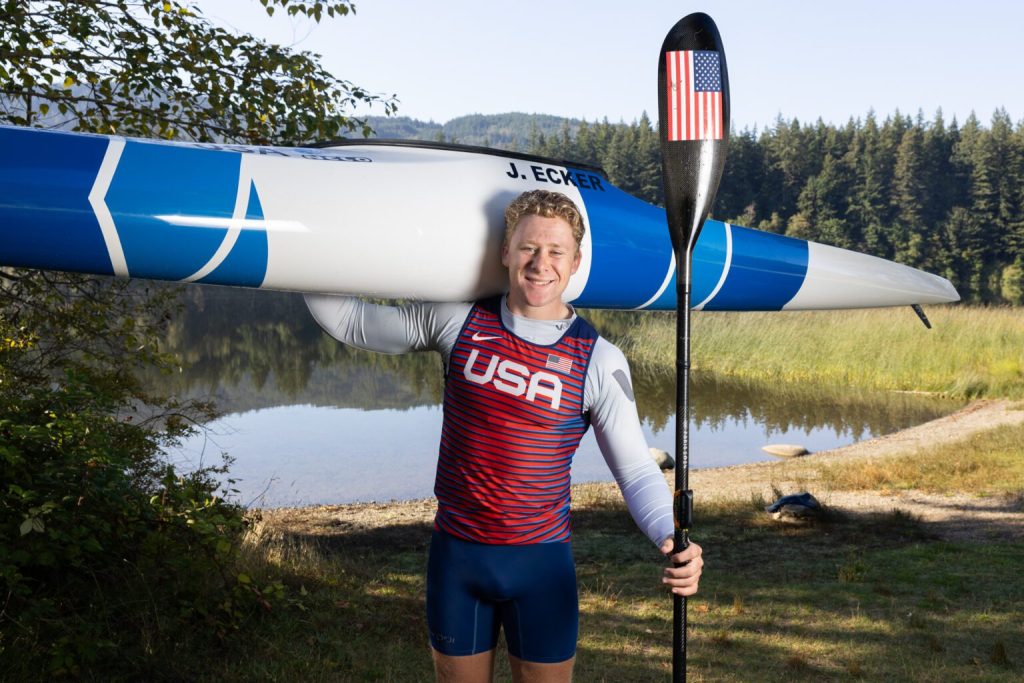
Date of birth:
26th October 2002
Results highlights:
Olympic Games: 8th K2 500 Paris 2024, 24th K1 1000 Paris 2024
U23 World Championships: 1st K1 1000 & 1st K1 500 Montemor 2025, 1st K1 1000 Plovdiv 2024, 3rd K2 500 Szeged 2022
Who is/was your canoeing idol?
Greg Barton
What’s your favorite distance and training?
My favorite distance to train for and race is the K1 1000m. I really enjoy aerobic base training and the feeling of how the boat runs at high speed and (relatively) low stroke rate.
Favorite paddle and boat?
Jantex Gamma 780 and NELO 7 XXL
Which is your favorite training spot?
When I am training at home my favorite spot is Lake Samish (Bellingham, USA), but my favorite place for a training camp is US Olympic and Paralympic Training Site: Chula Vista (Chula Vista, USA)
Do you have a motivation song?
Victory Lap (Fred again.., Skepta, and Plaqueboymax)
Could you give any advice for beginners?
My biggest advice to beginners is to “Trust the process.” Especially at a young age it is important to remember that progress is not linear and there will be set backs, but as long as you are consistent and focused you will improve over time.
Growing up in the United States, what were the biggest influences that shaped you as an athlete?
Growing up I think my biggest athletic influences were my parents. I didn’t follow professional sports much has a child, but both my parents were/are high performance athletes. My mother rowed during university before starting to kayak and my father was a competitive cyclist and dualthete (cycling/running). I grew up in a very active household where almost all of our quality time together was centered around being outdoors. I would bike while my dad ran or go paddling with my mom. Both of them always encouraged me to enjoy being active, and although they never pressured me to pursue elite athletics, they set incredible examples.
Do you have any pre‑race rituals or routines that help you get into the right mindset?
To get into the right mindset or head-space for racing I find it best to follow the same routine that I do in training and in time trials. Repeating the same process and warm-up helps me focus on the performance rather than on the competition or stakes surrounding the result. It also helps be sure that I can prepared in the best way possible and control as many variables as I can.
How do you mentally prepare for high‑pressure races?
I prepare for high-pressure races through following my routine, journalling, and visualization. The day or morning before a key race I will write out my timeline or routine for the day before the race as well as laying out all my gear and kit for race day. Additionally, I will write out my race plan and visualize it from start to finish, focusing on technical queues and race calls.
What’s one training habit or routine you consider essential for your success?
I think consistency and self-discipline are essential to my success. I primarily train alone, so when the weather is poor or I’m feeling tired and it could be easy to skip a workout, I find myself refocusing on my goals and reminding myself that ‘not every workout has to be great, but that every workout has to get done’.
What changes or innovations do you think will shape the future of canoe sprint?
I find it hard to imagine any large scale changes to canoe sprint at the olympic level, given boat and paddle designs have been coalescing into more and more uniform designs. However, I would be incredibly excited to see development of hydro-foil technology paired with canoe sprint. I know that prototype designs have been tested by different engineers, but I would love to see how fast a K4 on foils could go.
If you weren’t a professional kayaker, what do you think you’d be doing today?
If I wasn’t a professional kayaker I would likely be pursuing a graduate degree in Marine Biology. I obtained a Bachelor of Science in Marine Biology back in 2024 and was really intrigued and excited by the prospect of conducting research. Unfortunately, fieldwork and high performance training are not very compatible so for now I have chose to pursue kayaking. After my career in sport ends, I could absolutely see myself returning to academia or research science.
Are there any technical details you pay special attention to when preparing your boat?
When preparing my boat I always make sure that the telescoping tiller bar is taped and that there is a stopper for the bottom of my footplate. I have had too many sessions where I have lost my tiller or broken my footplate.
What goals are you currently focused on for the upcoming seasons?
This season I am most focused on improving my personal performance, I would really like to improve my time in both the K1 1000m and K2 500m. Additionally, I hope that by improving these performance I will see myself in a senior A Final for both of these events.
How are you adapting your training specifically with LA 2028 in mind and what are your expectations?
I don’t think that I am changing how I am training in preparation for LA 2028. I absolutely feel the increase of energy surrounding sport in the USA as the general public gets excited for the games, but as I always I am motivated by my love of the sport and the training and I just want to see what I can achieve when I put in 110%. I paddle because I love it, if I wasn’t competing I would still be training, the process is what brings me the most joy.